


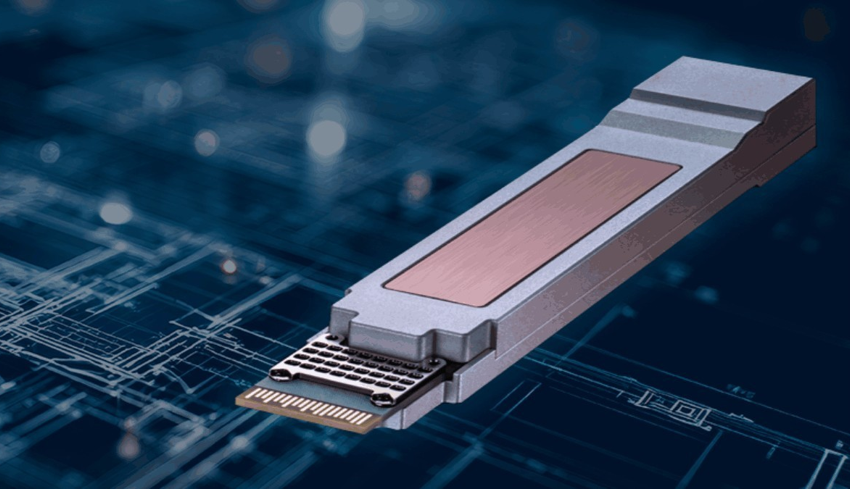
Photo / visual: A Cisco newsroom visual accompanying the announcement of USFP pluggable optics for AI infrastructure. Image credit unprovided
Cisco and NVIDIA Target AI Network Density Without Abandoning Pluggable Optics
- Technology
 Global Business Magazine
- 5 minutes read
The companies’ USFP design proposes a higher-bandwidth interconnect path while retaining a serviceable form factor familiar to data-center operators
The economics of large AI facilities depend on moving data as well as performing computations. Cisco and NVIDIA are targeting that infrastructure constraint with a new pluggable optics design announced October 12, 2026. Their Ultra-Dense Small Form Factor Pluggable approach, identified as USFP, aims to increase connection density while preserving the operational advantages of modules that can be installed and serviced separately from the surrounding equipment.
According to Cisco’s announcement, the design uses an OSFP-size footprint with 16 full-duplex lanes, 400-gigabitper-second electrical signaling per lane and a path to 12.8 terabits per second. Those specifications describe the companies’ announced architecture and development direction. They should not be taken as evidence that customers have already deployed equipment delivering the full stated bandwidth path in production AI facilities.
Cisco and NVIDIA claim four times the bandwidth density of 200G modules and 1.3 times the power efficiency. These are company-reported comparisons, not independently audited performance findings. For operators, the distinction matters: a module-level density or efficiency claim does not automatically establish the economics of an entire facility. System design, deployment requirements and operating conditions would need to be considered in any purchasing assessment.
The announcement also describes support for up to 100 watts without a dedicated embedded cooling circuit and introduces a new two-dimensional connector. These elements are part of the effort to accommodate denser connections within the stated footprint. The absence of a dedicated embedded cooling circuit should not be interpreted as eliminating cooling requirements elsewhere in an AI facility or proving a particular reduction in total operating expense.
“Building the world’s largest AI factories starts with rethinking the smallest of connections. With USFP, NVIDIA and Cisco are building an ecosystem to reinvent pluggable optics — connecting more computing with greater efficiency to power the next generation of AI factories.” That statement from NVIDIA Senior Vice President Gilad Shainer captures the companies’ strategic pitch: network interconnect design is a scaling issue, not merely a component detail.
TE Connectivity and Amphenol are developing cages, connectors and modules for the effort, according to the announcement. Their participation gives the proposal an ecosystem dimension beyond the two principal companies. It does not, by itself, establish broad market availability, completed interoperability testing or customer adoption. The supplied information supports a claim of component development, not a claim that a fully deployed supply chain has reached commercial scale.
For data-center operators, retaining pluggability is a significant part of the proposition. The design is presented as preserving serviceability, deployment flexibility and operational simplicity while increasing bandwidth density. These are operational objectives rather than demonstrated fleet-wide outcomes. Buyers would need to assess how the new connector and module design fit their maintenance practices, equipment choices and infrastructure plans before assigning a financial value to those objectives.
The business question is therefore broader than whether a smaller connection can carry more data. Operators must weigh density against power, cooling, replacement procedures and the availability of compatible components. Cisco and NVIDIA’s announcement tries to keep those considerations within a pluggable model rather than presenting higher bandwidth as sufficient on its own. That framing is particularly relevant when infrastructure expansion also increases the complexity of operating the facility.
The release provides an architecture proposal and partner commitments, not evidence of a completed customer rollout or independently measured system savings. USFP’s commercial significance will depend on execution across modules, connectors and supporting equipment. For now, the clearest development is the companies’ effort to make network density and serviceability advance together—a potentially important infrastructure direction, with its stated performance advantages still attributable to the announcing companies.