

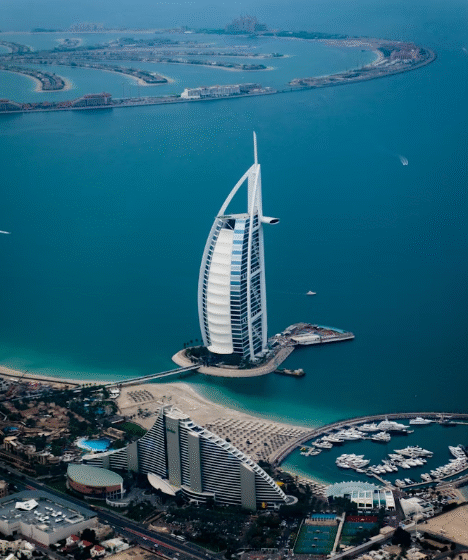
Dubai’s manic year keeps running — AED 23.8bn in one last-November week
- Economy News
 Global Business Magazine
- 7 minutes read
Dubai’s property market has left the “hot market” label behind and entered an altogether louder phase: exuberant, liquid and increasingly headline-grabbing. The latest weekly figures — transactions worth AED 23.8 billion in the single working week of November 24–28, 2025 — are more than a statistic. They are a statement: capital and confidence continue to pour into Dubai’s bricks-and-mortar story, and a healthy chunk of that cash is landing in the emirate’s luxury corridors.
What the numbers tell us at first glance is simple. Sales dominated the week, accounting for roughly AED 19.5 billion of the total, alongside mortgages and gift deals that underline both speculative activity and use-case buying (residency, family housing, wealth preservation). High ticket items punctuated the week: luxury apartments in Jumeirah developments such as Aman Residences and Solaya (Jumeirah) featured among standout sales, reinforcing the swirl of global buyers chasing safe, high-amenity assets.
But this is where the story forks. On one hand, the scale and velocity are spectacular: 2025 has already been a record year by many measures, with cumulative transaction totals and quarterly spikes that dwarf prior years. Khaleej Times and other market trackers have recorded unprecedented year-to-date values, while specialist outlets report that branded residences and trophy apartments are setting new price benchmarks. That momentum matters — it is what brings developers, foreign buyers and ancillary service industries to Dubai.
On the other hand, the pattern behind the headline figure is worth interrogating. First, a concentration risk: large single-ticket deals in Jumeirah and other luxury enclaves skew weekly totals and can make a market look deeper than it is. A handful of ultra-high-value purchases will lift totals dramatically even as broader segments (mid-market villas, affordable apartments for residents) face affordability pressures. ArabianBusiness and local sales trackers show that while ultra-luxury deals grab headlines, the volume of “everyday” transactions and the distribution of prices should be monitored carefully.
Second, the buyer mix matters. Reports through 2025 have consistently pointed to an increasingly diversified buyer base: not just regional GCC or South Asian investors, but more Europeans, Russians and North Americans. That globalization of demand is a strength — it reduces dependency on any single source of capital — but it also makes Dubai more correlated to international liquidity cycles, exchange-rate moves and geopolitical noise. In a world where U.S. rate guidance, energy prices and migration flows shift quickly, that correlation can amplify both upside and downside.
Third, supply dynamics and developer discipline are now pivotal. After the excesses of the last decade, many developers have been more cautious; yet Dubai still faces the perennial risk of new-launch waves and supply clustering. Analysts tracking the market through 2025 note disciplined launches compared with past cycles — but warn that supply built in the coming 18–36 months could test rents and yields in specific clusters. That is the late-cycle friction point: where landlord optimism meets real household affordability.
So, what should a reader actually take away? If you’re an investor, the headline AED 23.8bn week is evidence of liquidity — you can buy and sell at scale in Dubai. If you’re a homeowner or renter, the same news signals upward pressure on prices and rents, particularly in prized neighbourhoods. If you’re a policymaker or regulator, it’s a reminder that success breeds complexity: ensuring transparency, preventing speculation-led froth, and keeping the banking system insulated are top priorities.
There are immediate economic consequences, too. A strong real-estate cycle feeds into construction, services, retail and F&B — supporting jobs and tax-free income for residents — but it can also strain infrastructure and push living costs higher for non-property owners. Dubai’s branding as a lifestyle and investment hub is working: foreign real-estate firms are actively tapping the market, and secondary industries (fintech, hospitality, private schools) are expanding to meet demand. Yet the macro backdrop — rates, oil, and global capital flows — will be the governor of how long this sprint lasts.
A particular note on the luxury trophy deals: branded residences such as Aman Residences are not just homes; they are financial instruments in 2025 Dubai — a way for ultra-wealthy buyers to park capital in a legally transparent, service-heavy product that promises both lifestyle and potential capital appreciation. The flip side is price discovery: when a handful of units sell at stratospheric per-square-foot rates, comps shift and the market recalibrates — sometimes abruptly. Bayut’s transaction records for Aman Residences show the kinds of price points that are re-anchoring expectations.
What should the government and regulators do? Continue the transparency push (timely DLD reporting and scrutiny of mortgage-to-income ratios), keep developer approvals calibrated to realistic absorption rates, and maintain incentives that prioritise broad-based housing supply as much as headline-grabbing towers. Dubai’s policy playbook of residency-linked reforms and investor-friendly frameworks has been a key factor in attracting global capital; the task now is to balance magnetism with stability.
The economist view
Economists who’ve studied Dubai’s property cycle broadly echo a familiar theme: structural improvements, better developer discipline and strong foreign demand have made Dubai more resilient than in past booms — but the market is also in the “later innings” of a powerful upcycle and exposed to global liquidity shifts. The Economist’s recent analysis points out that while Dubai has avoided the excesses of the 2008 era and remains relatively affordable in some segments, the rapid price appreciation raises the risk of localized corrections if global conditions tighten. In short: healthy, but not bubble-proof. Read the Economist’s analysis here for a deeper, data-driven view.
Bottom line
AED 23.8bn in a single week is not a fluke — it’s the logical manifestation of a market that has become a global capital magnet. That is cause for celebration and for caution. Dubai’s miracle is built on policy, infrastructure and branding — and those pillars must be maintained with sober regulation if the emirate wants growth that’s both spectacular and sustainable.