


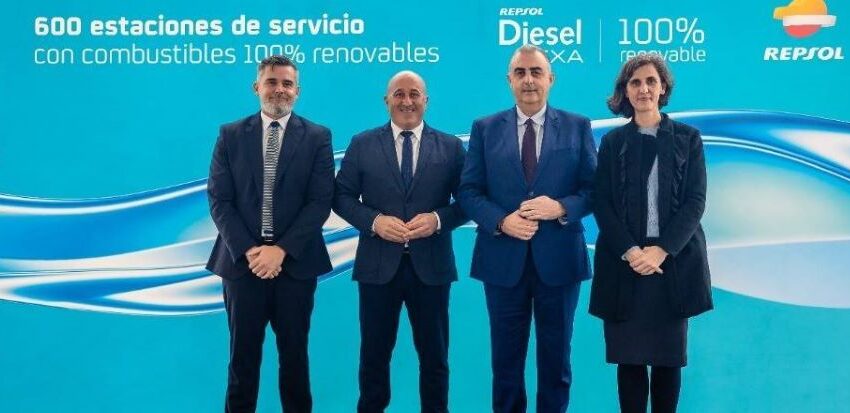
Repsol Opens 600th Renewable Fuel Outlet in Iberian Peninsula
- Business Companies Green Energy World
 Global Business Magazine
- 5 minutes read
In a significant achievement, Spain’s global energy company Repsol has opened its 600th renewable fuel supply station in the Iberian Peninsula by launching 100% renewable diesel at its service station in Cartes (Cantabria, Spain).
While 550 such tations are located in Spain, the remaining 50 are spread across Portugal. This accomplishment fulfills the target set in Repsol’s 2024-2027 Strategic Update to reach 600 stations with 100% renewable Nexa Diesel before year-end.
The multi-energy company plans further expansion, aiming for 1,500 stations offering 100% renewable fuel by the end of 2025.
The 100% renewable NEXA Diesel is produced from organic waste and, with current technology, already reduces net CO2 emissions by up to 90% compared to the mineral fuel it replaces, thanks to the lower carbon intensity of the renewable fuel due to its organic origin. It is also the top-of-the-range diesel on the Spanish market, with an exclusive formulation that optimizes performance, extends the life of the engine, and is designed for all diesel units.
The event was attended by Repsol’s Client Executive Managing Director Valero Marín, Director of Renewable Fuels Berta Cabello, the Regional Minister of Development, Housing, Spatial Planning and Environment of the Government of Cantabria Roberto Media; and the Mayor of Cartes Agustín Molleda.
Valero Marín said that this new milestone that Repsol has reached confirmed its commitment to increasing the range of sustainable technologies for mobility, helping customers to choose the one that best suits their needs.
“Renewable fuels are another alternative on offer in our extensive network of stations which enable immediate decarbonisation of the transport sector. We want to continue to be the travel companion of our customers, whether they use an electric car, a gas-driven car, or a car that runs on renewable fuels,” he added.
Berta Cabello said that renewable fuels were called to play a key role in the energy transition, as they fulfil the three pillars of energy policy: sustainability, competitiveness, and security of supply. “We are immersed in a profound transformation of the company, evolving our industrial complexes into multi-energy hubs with the capacity to generate products with a low or zero carbon footprint, promoting new business models based on circularity, digitalization, and technology,” Cabello added.
Renewable Fuels
To reduce emissions from mobility, Repsol is committed to a model that combines electrification, renewable fuels, and hydrogen. All energy solutions must be considered to guarantee supply and reduce greenhouse gas emissions as quickly and efficiently as possible.
Renewable fuels are produced from organic waste, such as used cooking oil or agri-food waste, giving a second life to such materials that can be generated locally and reduce energy dependence on other countries.
In addition, they are an already available alternative for the decarbonisation of current and future vehicles, without the need to change vehicles or modify existing distribution and refuelling infrastructures.
In this regard, Repsol announced last April the start of industrial-scale production of renewable fuels at its Cartagena facilities.
This plant, the first on the Iberian Peninsula dedicated exclusively to the production of 100% renewable fuels. It is the result of an investment of 250 million euros, and it has a production capacity of 250,000 tons per year. It can produce renewable diesel and sustainable aviation fuel (SAF), which can be used in any means of transport: cars, trucks, buses, ships, or airplanes, taking advantage of existing refuelling infrastructures.